
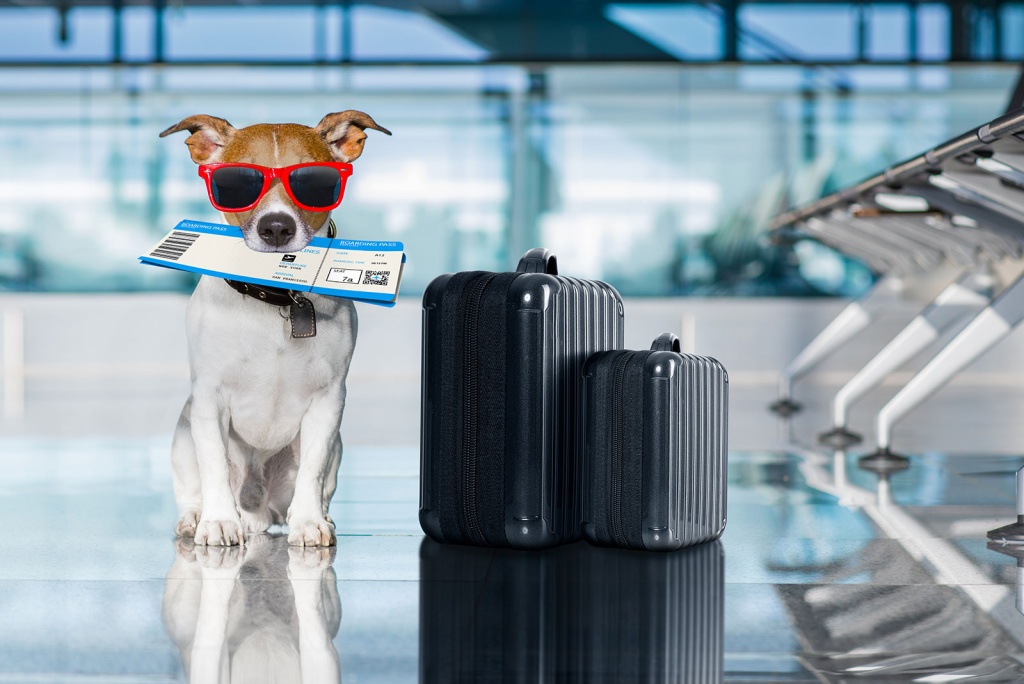
Taking pets abroad follows a strict sequence: first a microchip, then a rabies vaccination, then an antibody titre test, and only after that the paperwork. The steps can’t be rearranged, and preparation takes months.
We break down the EU requirements for taking dogs, cats and ferrets abroad: where to start, how long to wait between stages and what you need to show at the border when travelling with your pet.
What has changed in the pet travel rules
Since 22 April 2026, an updated package of veterinary legislation has applied in the EU: Regulations (EU) 2026/131, 2026/705 and 2026/636. They replaced the previous rules and rewrote some of the requirements, so guides from previous years no longer match practice.
Three changes pet owners need to know about:
- the antibody test period is counted from the date the animal health certificate is issued, not from the date you leave the country;
- within the EU, the animal health certificate is valid for six months rather than four;
- the requirements for forms and the declaration are set out in the new regulation.
Documents issued under the previous rules before 1 October remain valid until 31 March 2027. There is no need to reissue them in advance: the transition period bridges the gap, and your pet can travel on its existing certificate.
Step 1. Microchip: identifying your pet
The first step is microchipping. The microchip must comply with ISO 11784 and ISO 11785: only this type of chip can be read by the scanner at any border crossing. The procedure is painless: the chip is placed under the skin at the withers, and its code is recorded in the database and in the pet passport.
A tattoo is still accepted as identification only for animals marked before 3 July 2011 and is not accepted in any other case. All other pets need an international microchip: without one, your pet cannot travel abroad.
The order matters: your pet must be microchipped before its first rabies vaccination. If the jab was given earlier, it will have to be repeated, as vaccination cannot come before microchipping.
Step 2. Rabies vaccination
Rabies vaccination is compulsory for the animals the EU classes as pets: dogs, cats and ferrets. The vaccine is given from 12 weeks of age, so a puppy or kitten younger than that cannot be taken abroad.
The primary vaccination becomes valid 21 days after the course is completed. Until then, the animal is considered unvaccinated, and no paperwork will change that.
Booster vaccinations must be given no later than the date stated in the pet passport. If there is a gap, the clock starts again: a 21-day wait and, for countries outside the EU, a repeat blood test as well.
Every rabies vaccination must be recorded in the pet passport: the vaccine name, batch number, date, period of validity and the vet’s signature.
Step 3. Antibody titre test
A rabies antibody titre test is required for animals from countries that are not on the EU lists. Ukraine is not included in Annexes I and II to Regulation 2026/636, so the test is compulsory for anyone taking a pet out of the country.
Blood is taken no earlier than 30 days after the jab. The result must show a level of 0.5 IU/ml or higher — confirmation that your pet’s body has responded to the vaccine.
This detail is easy to miss: the blood sample must be taken at least 90 days before the animal health certificate is issued. The old formula counted from the trip, the new one counts from the paperwork, and these are different starting points.
The test must be carried out by an EU-approved laboratory: there are three in Ukraine, all in Kyiv. Results from anywhere else will not be accepted. The sample is sent off by the vet, who also records the result in the pet passport.
There is no need to repeat the test as long as booster vaccinations are given on time: it remains valid as long as the chain is unbroken.
Step 4. Pet passport and Form No. 1 certificate
A European-style pet passport is issued at a veterinary clinic. It records the owner, a description of the animal, the microchip code, and vaccinations and treatments. The entries are duplicated in English so that they can be read abroad.
A passport alone won’t get your pet across the border. For the trip you also need veterinary Form No. 1 — a certificate that is later exchanged for an international certificate. It is issued by the state veterinary service after a clinical examination, no more than five days before the animal travels.
To obtain the certificate, the pet’s owner must bring:
- the passport showing the microchip and the rabies vaccination;
- the antibody titre test report;
- an identity document.
The examination is carried out at a state clinic or at a private one, provided it is authorised to issue such certificates. Check the list in advance: in small towns, appointments are not available every day.
Step 5. International animal health certificate and declaration
At the border, the Form No. 1 certificate is exchanged for an international certificate. It is issued by the border inspection department: the inspector checks the microchip, the vaccination records and the laboratory report.
For entry, the animal health certificate is valid for ten days, and for travel by sea it is extended for the duration of the voyage. Within the European Union, the certificate is valid for six months or until the rabies vaccination expires, whichever comes first.
Together with the certificate, the owner signs a written declaration that the movement is non-commercial and that the animal is not intended for sale or transfer to a new owner.
A pet may travel without its owner, but only with an authorised person and within five days before or after the owner’s journey. Each such trip must be backed by documents proving the link between the owner and the pet.
How far in advance to start preparing
Even with the minimum waiting periods, about four months pass between microchipping and the trip. Most of that time goes on two waiting periods: after the rabies vaccination and before the paperwork. The exact figures are in the table.
| Stage | When | Proof |
| Microchipping | before the jab | microchip code in the passport |
| Rabies vaccination | from 12 weeks | vaccination record |
| Wait after the jab | 21 days | vet’s entry |
| Antibody titre test | 30 days after vaccination | test report |
| Wait before the paperwork | 90 days | counted from the test report |
| Form No. 1 certificate | before departure | state service form |
| International certificate | at the border on exit | inspector’s document |
Planning a holiday or a show? Count backwards from your departure date, not forwards from today. That way you can see straight away which stage is already running late.
Parasite treatment and countries with special requirements
Vets recommend treatment against fleas, ticks and worms before any journey, but it is compulsory for only five destinations: Finland, Ireland, Malta, Norway and Northern Ireland. These require protection against the Echinococcus tapeworm.
The rules are strict: a praziquantel-based treatment is given 24–120 hours before entry, and the vet records it in the passport. For Poland, Germany, Czechia and the rest of the EU, deworming is not among the compulsory procedures, even though many guides claim otherwise.
Some countries add their own requirements regarding dog breeds and quarantine. Check them on the website of the destination country’s veterinary authority: the rules there change more often than the general European ones.
The general European Union rules give access to the bloc’s countries, and everyone must comply with them. Anything beyond that is set by individual countries, and you need to find out about it before buying tickets.
How to travel with a pet: car, train or plane
The documents and rabies vaccination are the same for any mode of transport, but the rules for carrying pets differ.
Pets are calmest travelling by car: a carrier or harness, stops for water and walks, and your own schedule. Queues at the border crossing can last for hours, so bring a bowl and food. Pets wait to cross the border in the same place as passengers — there is no separate lane.
On Ukrzaliznytsia (Ukrainian Railways) trains, small animals travel in a carrier with a waterproof bottom, while large dogs must wear a muzzle and be kept on a lead, with the neighbouring seats bought as well. A separate ticket is issued for the animal.
Air travel requires a container that meets IATA requirements: the animal must be able to turn around freely while standing, sit upright and lie down in a natural position, and for short-nosed breeds the container should be 10 % roomier. Book your pet’s place when you buy your ticket, as the number of animals allowed on board is limited.
Birds, rodents and exotic animals
The common European rules are written for dogs, cats and ferrets. For a bird, rabbit, rodent or reptile, the entry conditions are set by the destination country, and they vary more than you might expect.
Typical requirements for such animals:
- a veterinary certificate of the animal’s health and origin;
- quarantine or a laboratory test before departure — most often for birds;
- a CITES permit if the species is protected: tortoises, macaws, some snakes.
The CITES permit must be obtained by the owner, and the process takes weeks. Entry rules for animals and birds depend on the destination country and on each species: there is no single list covering all exotic animals.
What is checked at the border
Pets can’t cross at just any checkpoint, only where there is a veterinary post for travellers: on the Polish border, these are Dorohusk and Korczowa. The inspector scans the chip and checks the code against the records, then goes through the list:
- the international animal health certificate for the country of entry and its validity;
- the dated rabies vaccination record;
- the blood test report;
- the declaration that the trip is non-commercial.
One person may take no more than five animals. More are allowed only for competitions and shows: each animal must be over six months old, and participation must be confirmed by a document from the organiser.
Any mismatch between the documents and the chip will stop you at the border. Before travelling, check the requirements of Ukraine’s State Service on Food Safety and Consumer Protection and Poland’s Veterinary Inspectorate: this is the part of the rules that changes most often.